
By Mary Elizabeth Geiger, Garfield & Hecht, P.C.
Owners and potential purchasers of real property in Aspen city limits should be aware that the City of Aspen is overhauling its Land Use Code (the “Code”) effective August 8, 2022 with regard to redevelopment of single-family homes and duplexes, affordable housing mitigation fees and short term rental licenses. This article briefly summarizes highlights of some of these changes; however, it is not meant to be relied upon as legal advice or creating any attorney-client relationship, and it does not necessarily address each and every provision of the upcoming changes to the Code. These Code changes are only effective for properties located within Aspen city limits – properties located in other municipalities are subject to those municipal regulations and properties located in unincorporated Pitkin County are subject to County regulations.
Redevelopment of Single-Family Homes and Duplexes
On June 28, 2022, the Aspen City Council adopted, on second reading, Ordinance No. 13, Series 2022, which overhauls many sections of the City’s Land Use Code (“LUC”), including, but not limited to, the “Definitions” section (which changes the definition of “Demolition” as discussed in more detail below) and the calculation of floor area as it pertains to affordable housing mitigation fees. These two changes are summarized herein; however, this Ordinance consists of a massive 206 pages and other aspects of the changes to the LUC may affect a project.
Determining Demolition (applicable to single-family homes and duplexes)
“Demolition” has been redefined to mean the razing, dissembling, tear down or destruction of 40% or more of a structure, as measured by the existing (before demolition) surface area of all existing exterior walls above finished grade and roof (not including fenestration or more commonly known as the arrangement of windows and doors) and the amount of this same area to be removed – including new fenestration. If a project constitutes demolition, then it can only proceed forward to building permit if there is an available demolition allotment. Demolition allotments are limited to six (6) per calendar year, and are considered on a first-come, first-served basis. Only applications that are deemed “complete” pursuant to the LUC then are in line for a demolition permit. The City will be considering these allotments for submissions occurring on and after August 8, 2022, for the 2022 permits and then again on January 1, 2023, for that calendar year, then January 1 each year thereafter. If an application is deemed complete but there are no more demolition allotments for that year, there are a couple of exceptions for which an owner can apply but they are extremely limited. This demolition allotment is a significant change to the LUC as previously the only limiting allotments were Growth Management Quota System allotments (“GMQS”). The GMQS (discussed below) is still in effect but further limited by the availability of a demolition permit. If a project is under the 40% threshold, then it will move through the permitting process.
GMQS
All land use and building permit applications are subject to the City’s Growth Management Quota System or “GMQS,” found at Chapter 24.470 of the Code. The City limits the number of annual development allotments pursuant to this system and provides exemptions from these limitations. This Chapter was also amended by Ordinance No. 13, Series of 2022. For example, only 19 free-market residential development allotments are available each year, 13 allotments for new residential and 6 allotments for demolition redevelopment as described above. Single-Family Residential development that does not trigger demolition is exempt from this limitation as is the remodeling of existing Multi-Family Residential Units and Historic Structures. The Community Development Director determines whether a project is subject to GMQS pursuant to the procedures and criteria set forth in this chapter.
Changes to Affordable Housing Mitigation
Ordinance No. 13, Series 2022 also amended the LUC with regard to affordable housing mitigation required for residential redevelopment, both that which qualifies as demolition and that which does not. There is still the opportunity to mitigate affordable housing by providing deed restricted units; however, most projects will end up paying fees-in-lieu of such provision, which is discussed herein. The biggest change is that starting August 8, 2022, in determining the number of Full Time Employees (“FTEs”) generated by a project and requiring mitigation, the City will include the subgrade square footage, garages, carports, crawl spaces that are more than 6 feet in height and attic space that is easily accessible and can be made habitable. If the project is considered demolition, then all of the square footage for the finished project is utilized to calculate the FTEs. If the project is not considered demolition, then only the new, additional square footage is counted. Prior to these changes, only the above-grade, new livable floor area counted for such calculations.
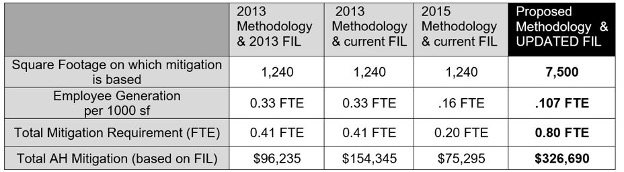
The City did reduce obligations regarding FTEs generated by 1000 square feet from 0.16 FTE to 0.107 FTE. However, City Council also adopted Ordinance No. 14, Series of 2022, which increases the fee-in-lieu (“FIL”), for each Category of affordable housing units (as defined by the Aspen/Pitkin County Housing Authority (“APCHA”) – most commonly, projects will pay for Category 2 which is $408,362 per FTE. The below table is illustrative and shows how this would be calculated in a demolition scenario compared to in previous years:

In this scenario, the basement and garage add another 4,260 sf to the new home for FTE calculation.
Short Term Rental Licensing Changes
The City’s moratorium on issuing new short-term rental permits does not expire until September 30, 2022. At that time, new permits will be governed by Ordinance No. 9, Series 2022. However, this Ordinance is effective as of July 29, 2022, with regard to existing permits. This Ordinance amends the definitions in Section 26.104.100 of the LUC with regard to terms for determining short-term rentals, including “owner occupant,” “pillow” (a unit of measurement for assessing affordable housing generation and occupancy of lodge rooms/units per bedroom in a short-term rental – for instance murphy beds and sleeper sofas shall count as two pillows), and, most importantly, “Short Term Rental (STR)” as being “the use or occupancy of a residential property or dwelling unit, in whole or in part, by the general public for a fee, primarily for tourist accommodations, and for a period of less than 30 days. Timeshare, hotel, motel and bed and breakfast uses are not short-term rental uses.
Valid 2022 STR permits (being vacation rental permits issued on or prior to December 8, 2021) remain valid through December 31, 2022 and may be renewed thereafter only by the same owner for the same property, subject to the new rules set forth in the updated Chapter 26.530 of the LUC, until such time as they are revoked or abandoned. At that time, the owner will be subject to the new STR Permits zone-district limitations set forth in that Chapter. To be clear, if there is a sale of the property to a new owner, the permit is non-transferable.
Commencing on October 1, 2022, this new Chapter 26.530 of the LUC will govern the issuance of STR Permits. They will be non-transferrable. For single-family residences, these may be either STR-C (Short-term Rental Classic) or STR-OO (Short-term Rental Owner-Occupied); the latter allowing for the vacation renal of a primary residence of the permittee. However, the biggest change is that the number of STR-C permits are limited in all zone districts except for commercial zone districts. Depending on the zone district in which the property is located, there may be only 1-2 permits allowed therein. Permit applications are processed on a first come, first served basis after they have been deemed complete by the City. The City will create waitlists once the permit limit is met for each zone district but all permits are renewable so these waitlists could take years. For these permits there is no limit on the number of nights per year in which it is rented. However, for STR-OO units, the limitation is 120 nights per year (of short-term rentals).
There are many other changes regarding operational standards for permittees as well as the process for applying for a permit. The City will be adopting guidelines for the same prior to October 1, 2022.
For more information on these important changes to the City of Aspen’s Land Use Code or as to any matter involving development within Aspen city limits or land use issues generally, please contact:
Mary Elizabeth Geiger (megeiger@garfieldhecht.com or (970) 947-1936 x813)
David H. McConaughy (dmcconaughy@garfieldhecht.com or (970) 379-7845 x810)
Chris J. LaCroix (clacroix@garfieldhecht.com or (970) 925-1936 x204)
Chris Bryan (cbryan@garfieldhecht.com or (970) 925-1936 x802)
Andrea Bryan (abryan@garfieldhecht.com or (970 925-2642 x645)



