By Benjamin L. Monarch, Garfield & Hecht, P.C.
In the mid-to-late 1800s a series of laws were passed that became collectively known as the Homestead Acts. The general purpose of the Homestead Acts was to distribute federal land to private citizens to establish and develop a permanent population in the American West.i According to the National Park Service, approximately 270,000,000 acres were distributed by the federal government under the Homestead Acts between 1862-1934. Although homesteading began to wane before the 1930s, the Great Depression and its policy response, the New Deal, sparked renewed policymaking interest in encouraging citizens to settle west of the Mississippi River. To that end The Small Tracts Act of 1938 was enacted on January 12, 1938.ii
The Small Tracts Act (“STA”) of 1938 authorized the Secretary of Agriculture to convey certain National Forest System lands, and it included language permitting the Secretary to convey a right-of-way for public access and utilities with each transfer. The lands that were transferred were interspersed with or adjacent to federal lands, so they were required by statute to be small by historic standards; usually ten or so acres. Access easements for STA lands were managed by the General Land Office, which eventually became part of the Bureau of Land Management.
By 1945, the General Land Office had developed a practice of conveying an express easement of 33’ to 50’ along one or more boundaries of an STA parcel for access roads and utilities.iii On relatively flat topography, building roads and extending utilities along boundary lines is straight forward and practical. However, on rugged topography, like that found throughout Colorado, boundary lines can be on steep, treacherous terrain where access road construction is not feasible. The General Land Office did not always consider this dilemma and this oversight resulted in access easement conveyances under the STA that were technically and theoretically valid, but flawed. In application, these right-of-way grants were readily ineffective and useless on rugged land because the typical property owner lacked the means and/or expertise to build an access road along a boundary line that, for example, ran perpendicular to a 65○ mountain slope. The General Land Office failed to observe the teachings of John Wesley Powell that in landscapes like Colorado humans often exist at the mercy of terrain, not in dominion over it.
Unsurprisingly, property owners resorted to carve out access roads in accord with the land’s characteristics, not simply along boundary lines. As a present-day consequence, there are access roads among historically STA parcels that provide physical access but exist in a legal no-man’s land; these roads are literally used but their users lack the formal recognition of an easement for that use.
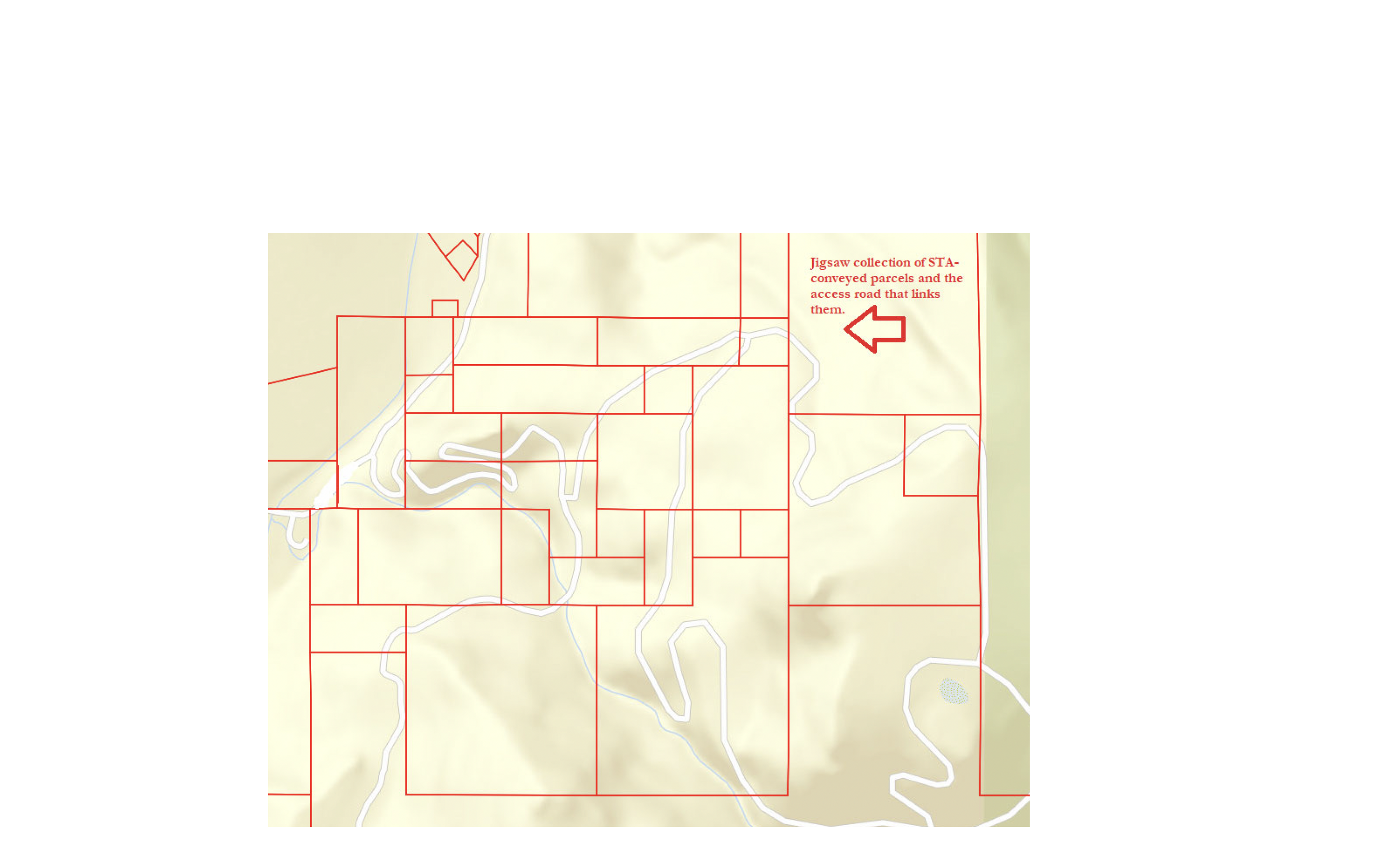
For instance, there is a dirt road near the border of the White River National Forest that traverses approximately fifteen private properties along a mountain side.iv The road is in good repair and is known to exist since at least 1959. However, most of the property owners that use the road to access their parcels lack formal legal access to do so. Records show that easements exist along the boundary lines of the parcels, as per General Land Officer conveyance, but the road does not abide by those provisions and restrictions.
As title research becomes more thorough by the digitization of records, situations like the one described in the preceding paragraph result in title commitments that flag properties for lacking legal access. This can jeopardize transactions that require formally recognized access. While there are solutions to this problem, they should not wait until a sale contract is signed that depends on their resolution. There is the risk that remediation could demand more time than the contract signatories find acceptable.
Each situation is different, but generally the problem described can be resolved through an effort to obtain express easements from willing parcel owners along the road, or through judicial decree recognizing a prescriptive easement to use a road that has been used for the statutorily required timeframe. The latter resolution could require significant time and cost. Easement by necessity is another legal theory to consider, but not all situations support this approach. In any event, there are proactive avenues for avoiding an unexpected and unwelcome title commitment that declares a property lacks legal access.
It is not always known to property owners that a specific mountain parcel originated from an STA conveyance. Moreover, even when a property owner knows a parcel came from an STA conveyance, they may assume the boundary line easement on the original deed from the federal government is sufficient. This may be a flawed conclusion. So, the next time someone is driving that old, worn dirt road across someone else’s land to reach their weekend cabin, they should ask, “Am I sure I have a recognized legal right to be here?” The answer could be surprising.
For more information or questions about access to property, especially parcels in remote terrain, contact:
Glenwood to Rifle: David McConaughy (dmcconaughy@garfieldhecht.com or (970) 925-1936 ext. 200), Ben Monarch (bmonarch@garfieldhecht.com or (970) 927-1946) Mary Elizabeth Geiger (megeiger@garfieldhecht.com or (970) 947-1936 ext. 811)
Carbondale: Kelcey Nichols (knichols@garfieldhecht.com or (970) 425-8199 ext. 221)
Aspen to Snowmass: Ron Garfield (garfield@garfieldhecht.com or (970) 925-1936 ext. 200), Christopher LaCroix (clacroix@garfieldhecht.com or (970) 925-1936 ext. 204) or John Belkin (jbelkin@garfieldhecht.com or (970) 925-1936 ext. 215)
Crested Butte: John Belkin (jbelkin@garfieldhecht.com or (970) 925-1936 ext. 215)
Denver and Front Range: Kursten L. Canada (kcanada@garfieldhecht.com or (970) 949-0707 ext.853) or Jason Buckley (jbuckley@garfieldhecht.com or (720) 961-9029 ext. 851)
Avon and the Vail Valley: Tracy L. Kinsella (tkinsella@garfieldhecht.com or (970) 949-0707 ext.854) or Kursten L. Canada (kcanada@garfieldhecht.com or (970) 949-0707 ext. 853)
i Notably, the Homestead Acts did not benefit Native Americans, rather they tended to contribute to the depletion of resources utilized by Native Americans. Nothing in this Article is intended to minimize the negative consequences this policy created for Native Americans, rather the focus here is on how the policy of the Homestead Acts created many of the private properties that now exist in the American West, and Colorado in particular.
ii National Forest System Land Conveyance, 16 U.S.C. § 521(c); Public Law 97-465 (97th Congress). The Small Tract Act of 1938 was repealed by the Federal Land Policy and Management Act of 1976 and should not be confused with the Small Tract Act of 2002.
iii See attached BLM Memorandum No. 91-196.
iv The attached map displays a winding road that traverses many STA parcels. At times the road is within range of the express easement conveyed with the land by the General Land Office, but often it is not.